Parte del contenido permanece en su idioma original hasta que se revise su traducción.
Morning market brief
Stocks finish lower. Oil and US inflation set Friday’s agenda.
A review of the past 24 hours across stocks, oil, currencies and UK growth, with conditional scenarios for the next trading day.
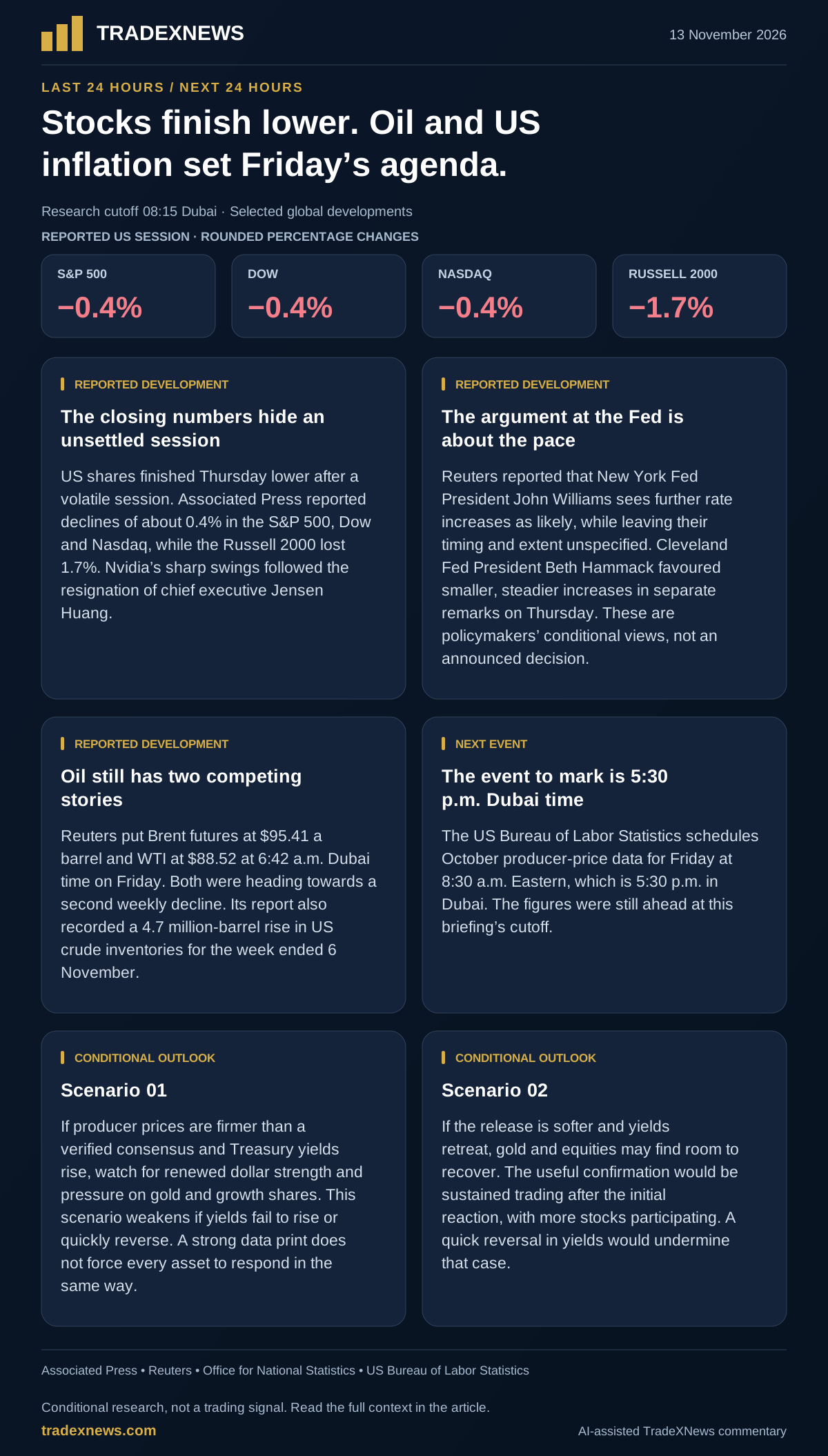
The closing numbers hide an unsettled session
US shares finished Thursday lower after a volatile session. Associated Press reported declines of about 0.4% in the S&P 500, Dow and Nasdaq, while the Russell 2000 lost 1.7%. Nvidia’s sharp swings followed the resignation of chief executive Jensen Huang.
The gap between large and small companies is the detail to carry into Friday. In our reading, an index recovery would be more persuasive if participation widened. Another narrow rebound would leave that question open.
The argument at the Fed is about the pace
Reuters reported that New York Fed President John Williams sees further rate increases as likely, while leaving their timing and extent unspecified. Cleveland Fed President Beth Hammack favoured smaller, steadier increases in separate remarks on Thursday. These are policymakers’ conditional views, not an announced decision.
For the next session, watch how short-dated Treasury yields respond to fresh inflation data. A rise in yields accompanied by a firmer dollar would make a sustained recovery in rate-sensitive assets harder to argue for. If yields ease instead, that reading needs to change with them.
Oil still has two competing stories
Reuters put Brent futures at $95.41 a barrel and WTI at $88.52 at 6:42 a.m. Dubai time on Friday. Both were heading towards a second weekly decline. Its report also recorded a 4.7 million-barrel rise in US crude inventories for the week ended 6 November.
Supply uncertainty and inventory accumulation can pull prices in opposite directions. Treat a fresh shipping headline as something to verify, then check whether the move survives. This is a scenario to monitor, not evidence that a supply loss has occurred.
Britain’s growth figures deserve their own reading
The UK’s Office for National Statistics estimated third-quarter growth at 0.7%, after 0.5% in the second quarter. Services expanded by 0.9%, while construction contracted by 0.7%. Released on Thursday, these figures describe July to September, not growth over the past day.
That mix gives sterling traders a domestic story to assess alongside US rates. It does not establish a direction for the pound. A stronger UK release can still coexist with a falling GBP/USD rate if the dollar strengthens more broadly; that is a possibility, not an observed reaction claimed here.
The event to mark is 5:30 p.m. Dubai time
The US Bureau of Labor Statistics schedules October producer-price data for Friday at 8:30 a.m. Eastern, which is 5:30 p.m. in Dubai. The figures were still ahead at this briefing’s cutoff.
Read the monthly and annual changes separately, then check revisions and the underlying categories. Compare the result with a timestamped consensus from your calendar provider. An unpublished forecast or an old survey should not quietly become the benchmark. The release schedule can change, so check it again before the event.
The next 24 hours: three scenarios to keep open
Our working view is cautious and conditional. The main test is whether the inflation release changes the rates picture, and whether other markets confirm that change.
If producer prices are firmer than a verified consensus and Treasury yields rise, watch for renewed dollar strength and pressure on gold and growth shares. This scenario weakens if yields fail to rise or quickly reverse. A strong data print does not force every asset to respond in the same way.
If the release is softer and yields retreat, gold and equities may find room to recover. The useful confirmation would be sustained trading after the initial reaction, with more stocks participating. A quick reversal in yields would undermine that case.
If a verified energy-supply disruption takes priority, oil may dominate the session. Gold’s response would remain uncertain because defensive demand and higher-rate concerns can compete. Do not assume that all perceived safe havens will rise together.
A practical way to approach the session
Before taking a position, write down the observation that would invalidate your idea. Keep it specific: a reversed yield move, a failed recovery in market breadth, or an official correction to a supply report. “The market should come back” is not a useful condition.
Check spread, liquidity and order behaviour around the release. Several positions in gold, the dollar and US equities can express the same underlying rates view, even when the instruments look different. Review that combined exposure before adding another trade.
For bitcoin and ether, this edition does not establish a verified spot price, daily return or derivatives-positioning signal. Apply the same event-risk discipline, but check crypto’s own liquidity and price action before carrying a stock-market interpretation across.
The outlook ends on Saturday morning. Review weekend exposure against the actual trading hours and execution rules of each venue. A stop trigger is not a guarantee of the eventual exit price.
Lectura de fuentes
- Associated Press · US market close, 12 November
- Reuters · Williams on interest rates, 13 November
- Reuters · Hammack on gradual rate increases, 12 November
- Reuters · Oil futures, observation 06:42 Dubai, 13 November
- Office for National Statistics · UK third-quarter GDP, 12 November
- US Bureau of Labor Statistics · November release calendar